Hobart is Australia’s second oldest city and one of its most historically layered. From its beginnings as a British penal settlement on the banks of the Derwent River to its role as a thriving cultural capital, the city’s history is rich, complicated, and sometimes confronting. This site explores that history: the buildings, the people, the politics, and the events that made Hobart what it is today.

Settlement 1803–1804

          Van Diemen’s Land: named by Dutch explorer Abel Tasman, who reached the island in 1642 and named it after Anthony van Diemen, the Governor-General of the Dutch East Indies. This island has been home to Aboriginal Tasmanians for at least 35,000 years before British colonisation.

          The impetus to install a British settlement on Van Diemen’s Land rose from the concerns of Governor King in Sydney that Baudin, with the French expedition on the Naturaliste, was intending to settle on the east coast of Van Diemen’s Land. The Island was governed as a dependency of the colony of New South Wales. The Lieutenant-Governors and Commandants in charge of the settlements on Van Diemen’s Land were subordinate to the Governor in Sydney.

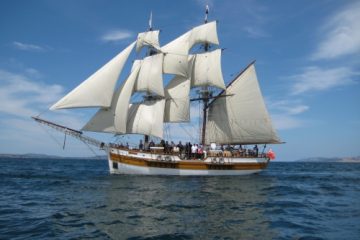
          The first British settlement was established at Risdon Cove on the eastern bank of the Derwent River in September 1803, when Lieutenant John Bowen arrived in the Lady Nelson, accompanied by the Albion. On board was a small party of soldiers, sailors, settlers, and convicts. The site Bowen chose, on advice from Matthew Flinders and George Bass, had poor soil and scarce water.

1799 Lady Nelson, Deptford, England

          When Lieutenant Colonel David Collins arrived in the Derwent from the abandoned settlement at Port Phillip in February 1804, he rejected Risdon Cove and moved his party across the river to Sullivan’s Cove, the site of what is now Hobart. The early settlement was precarious, dependent on supply ships and struggling with food shortages, and governed by the full weight of British military law.

The convict era 1804–1853

          For nearly fifty years Van Diemen’s Land was one of the primary destinations for transported convicts from Britain and Ireland. Over 69,000 men and women arrived under sentence, and their labour built the roads, bridges, and buildings that still define the city today. The convict era shaped Hobart’s social fabric, its architecture, its legal institutions, and its relationship with authority in ways that are still being understood.

Sullivan’s Cove & part of Hobart Image: TAHO AF394-1-170

Responsible self government 1856

          In 1856 Van Diemen’s Land became Tasmania, gained responsible self government, and ended public executions in the same year: three changes that signalled the colony’s transition from penal settlement to self-governing society. The new parliament, the reformed legal system, and the gradual emergence of a free settler majority began to remake the city in a different image.

Constitution Act 1855 (Tas) Image: Australasian Legal Information Institute

Federation and the twentieth century

          Tasmania joined the Australian federation in 1901 as one of its founding states. The twentieth century brought two world wars, economic transformation, and the slow reckoning with the convict past that Tasmanians had spent decades trying to forget and are now, rightly, learning to remember.

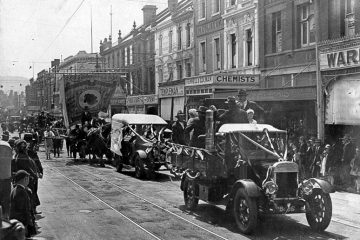
1901 – Federation of Australian States Image – National Library of Australia

Explore the site

          The articles on this site cover the full sweep of Hobart’s history — from the architecture of its oldest buildings to the politics of its earliest parliaments, from the stories of the people who shaped the city to the events that defined it.